

By Ted Byrer, CAS® · Retirement Income Specialist and Independent Insurance Agent · November 2, 2026
What Long-Term Care Costs in Indiana, and How Hoosier Families Plan to Pay for It
Indiana care costs, what Medicare and Medicaid do and do not cover, and the Indiana Long-Term Care Partnership.
Long-term care is the part of retirement planning that most families put off, because it is uncomfortable and the numbers are hard to find. This puts the Indiana numbers in one place: what care costs today, how those costs could grow, how care is paid for in Indiana, and the questions worth answering before a need arises.
Everything here is specific to Indiana. Cost figures are Indiana medians from the most recent CareScout Cost of Care Survey (2025), and the program rules come from Indiana’s Long-Term Care Program and Family and Social Services Administration (FSSA).
What care costs in Indiana today
Monthly and annual Indiana median costs, CareScout Cost of Care Survey 2025.
| Type of care | Monthly | Annual |
|---|---|---|
| Home care | $6,673 | $80,076 |
| Assisted living | $5,639 | $67,668 |
| Nursing home, semi-private room | $8,942 | $107,304 |
| Nursing home, private room | $10,326 | $123,912 |
| Adult day health care | $2,752 | $33,024 |
What the numbers include
- Home care. A non-medical caregiver for 44 hours a week, 52 weeks a year, at the Indiana median of $35 an hour. Family caregiving, a caregiver’s lost income, and out-of-pocket costs are not included.
- Assisted living. Twelve months in a private, one-bedroom unit. Services beyond the base rate can raise the monthly cost.
- Nursing home. The median daily rate for a semi-private or private room, annualized and divided by 12.
- Adult day health care. Five days a week. A lower-cost option that can support a family caregiver.
How costs could grow
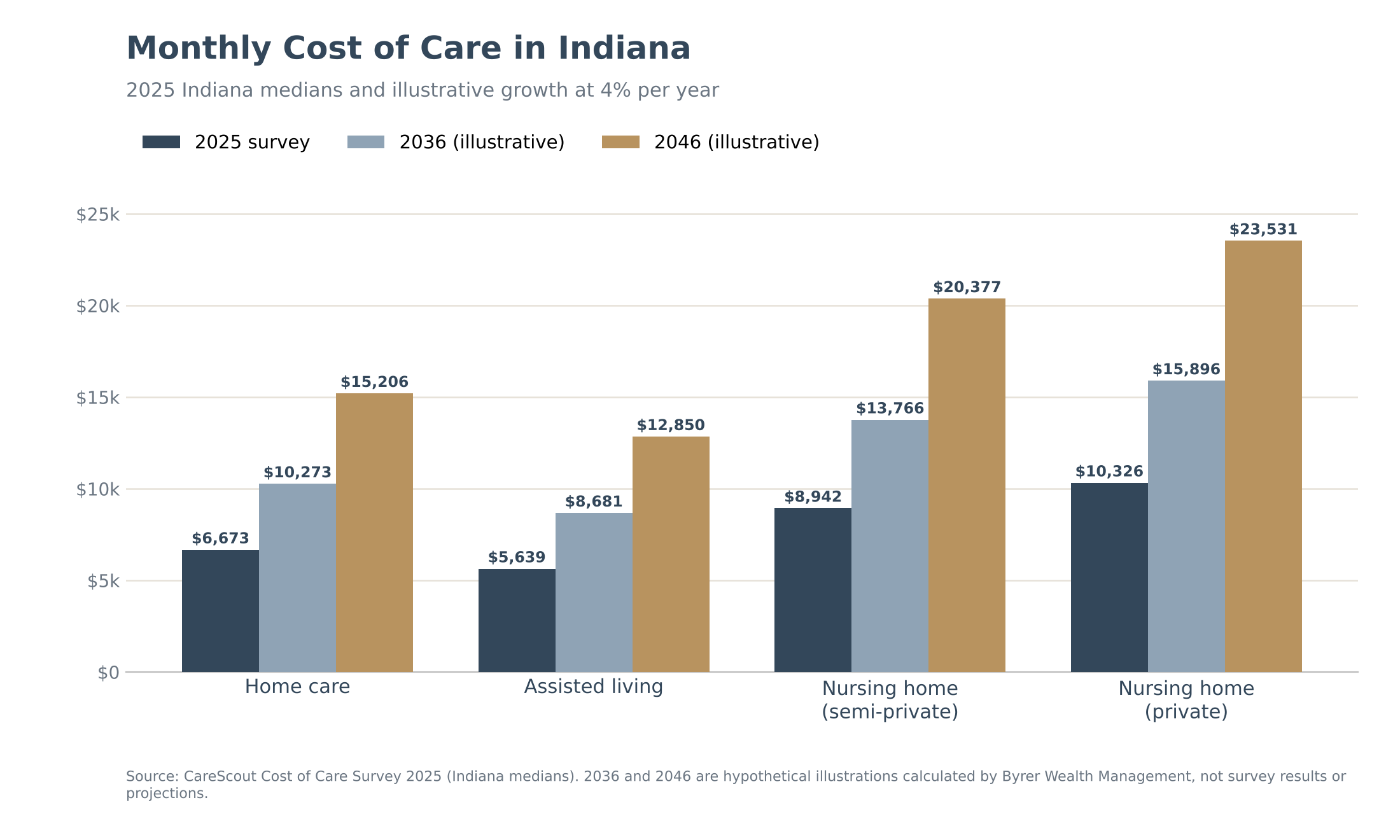
Costs rise over time. Applying a steady 4% annual growth rate to today’s medians shows what the same care could cost in 2036 and 2046. These are hypothetical illustrations, not forecasts.
| Type of care | Today (2025) | 2036 (illustrative) | 2046 (illustrative) |
|---|---|---|---|
| Home care | $6,673 | $10,273 | $15,206 |
| Assisted living | $5,639 | $8,681 | $12,850 |
| Nursing home, semi-private | $8,942 | $13,766 | $20,377 |
| Nursing home, private | $10,326 | $15,896 | $23,531 |
Private-room nursing home care, at $10,326 a month today, would be about $23,531 a month in 2046 at that growth rate.
What Medicare does and does not cover
Medicare is health insurance, not long-term care insurance. It generally does not pay for custodial care, which is help with bathing, dressing, eating, and other daily activities, whether at home, in assisted living, or in a nursing home.
What Medicare does cover is limited skilled nursing facility care after a qualifying hospital stay. In 2026, Medicare pays the full cost for days 1 through 20, then the patient pays $217 a day for days 21 through 100, and nothing after day 100. Medicare supplement policies generally follow Medicare’s coverage rules.
Indiana Medicaid and PathWays for Aging
Indiana Medicaid can pay for long-term care when a person has limited income and assets and needs a nursing-home level of care. Since July 1, 2024, Hoosiers 60 and older receive Medicaid long-term services through Indiana PathWays for Aging, a managed care program that covers nursing facility care and home and community-based services. People 59 and younger use the Health and Wellness Waiver.
The rules are strict, they change every year, and they should be confirmed with FSSA or an elder law attorney. These are the main 2026 figures.
| 2026 figure | Amount |
|---|---|
| Countable assets (single applicant) | $2,000 |
| Monthly income limit (single applicant, nursing home or waiver) | $2,982 |
| Look-back period for gifts and transfers | 5 years (60 months) |
| Community spouse resource allowance | $32,532 minimum; up to half of joint assets, maximum $162,660 |
| Community spouse monthly income allowance | $2,705 minimum; $4,067 maximum |
| Personal needs allowance (institutional spouse) | $52 a month |
| Home equity limit | $752,000 (the home is generally exempt below this) |
Two cautions. First, transfers made within the five-year look-back period can cause a penalty period during which Medicaid will not pay. Second, after death Indiana may seek repayment of long-term care costs from the remaining estate, which is often the home. Medicaid is a safety net, and using it generally means spending down savings first and accepting its choices of provider and setting.
The Indiana Long-Term Care Partnership
Indiana was one of the first states to create a Long-Term Care Partnership, now called the Indiana Long-Term Care Program. It connects private long-term care insurance with Medicaid: a person who buys a qualifying policy and uses its benefits can protect assets when later applying for Medicaid.
For every $1 of benefits the policy pays, at least $1 of assets is disregarded when determining Medicaid eligibility. A buyer who purchases coverage at or above the state-set amount for the year earns total asset protection once the policy benefits are used up. In 2026 that amount is $548,820. A buyer who purchases less earns dollar-for-dollar protection. Protected assets are disregarded, but income is not.
| Feature | What to know |
|---|---|
| Inflation protection | Required on every Partnership policy: 5% annual compound for total protection; 5% compound, CPI, or (issue ages 75 and older only) 5% simple for dollar-for-dollar protection |
| Minimum coverage | At least one year of nursing home care at the minimum daily benefit, which is $115 in 2026 |
| Portability | Benefits can be used in any state. For Medicaid asset protection, the policyholder generally must be in Indiana unless the other state has a reciprocity agreement with Indiana |
| State tax benefit | Premiums for a Partnership policy are deductible on the Indiana return (IC 6-3-1-3.5(a)(16)), in place since tax year 2000 |
| Who sells it | Private insurers and agents. The State of Indiana does not sell the policies |
To confirm that a policy is a Partnership policy, look for the bolded statement in the outline of coverage, application, or front page that it qualifies under the Indiana Long Term Care Insurance Program for Medicaid asset protection.
Tax treatment
Premiums for a federally tax-qualified long-term care policy may also be deductible on the federal return, within age-based limits and subject to the usual medical expense rules. The 2026 limits are $500 (age 40 and under), $930 (41 to 50), $1,860 (51 to 60), $4,960 (61 to 70), and $6,200 (over 70). Self-employed taxpayers may be able to deduct premiums more directly. Because the Indiana deduction is reduced by any federal deduction taken for the same premiums, a tax advisor should confirm how both apply.
Ways Indiana families plan to pay for care
| Approach | What it is | What to weigh |
|---|---|---|
| Savings and income | Paying from retirement accounts, savings, and monthly income | Large, uneven costs can drain a portfolio; the timing of withdrawals matters for taxes |
| Traditional long-term care insurance | Coverage that reimburses care costs up to daily or monthly maximums | Premiums depend on age and health when you apply; benefit period, elimination period, and inflation protection all matter |
| Hybrid life or annuity with long-term care benefits | A life insurance or annuity contract with a long-term care benefit built in | Often fixed premiums and a benefit if care is never needed; the long-term care benefit is typically smaller or costlier per dollar than stand-alone coverage, so compare carefully |
| Family caregiving | Care provided by relatives | Carries real costs of its own: lost income, health, and relationships |
| Medicaid | Coverage after assets are largely spent down | Strict eligibility, look-back, and estate recovery rules; less choice of provider and setting |
A closer look at hybrid coverage versus a traditional policy is in hybrid versus traditional long-term care insurance.
Questions to answer before a need arises
- Where would I want care, at home, in assisted living, or in a nursing home, and what would each cost in my part of Indiana?
- Who would help? Can family provide care, and what would it cost them?
- How would I pay for the first year of care, and for year five?
- Is my plan inflation-aware? Care costs rise over time, and a plan has to keep pace.
- If I own or buy a policy, does it qualify under the Indiana Partnership, and how does the benefit work if I move?
- Who else should be involved, such as my spouse, my children, an elder law attorney, and a tax advisor?
A simple planning timeline
| When | What to do |
|---|---|
| In your 50s and early 60s | Learn what care costs near you, talk with family, and understand your options. Health and age affect both eligibility and pricing for insurance, so many people look at coverage in this window. |
| Around retirement | Decide how care would be paid for: savings and income, insurance, a hybrid contract, or a combination. Coordinate with your spouse, your tax advisor and, if assets are significant, an elder law attorney. |
| Once care is needed | Use your Area Agency on Aging and FSSA resources to find services, review policy benefits and claim procedures, and, if Medicaid may be needed, speak with an elder law attorney before moving assets. |
Key terms
| Term | Meaning |
|---|---|
| Custodial care | Help with daily activities such as bathing, dressing, and eating, as opposed to skilled medical care |
| Activities of daily living | Six basic self-care activities used to decide when long-term care benefits begin |
| Elimination period | The waiting period after a claim starts before a policy begins paying |
| Benefit period | How long, or up to what total amount, a policy will pay |
| Inflation protection | A feature that raises the benefit over time; required on Indiana Partnership policies |
| Tax-qualified policy | A policy that meets federal rules so that premiums and benefits may receive favorable tax treatment |
Where to get help in Indiana
- Indiana Long-Term Care Program. Partnership policies, annual figures, tax information, and consumer guides.
- FSSA Division of Aging. Medicaid long-term care programs and PathWays for Aging.
- Indiana Department of Insurance. Insurer licensing, consumer complaints, and policy questions.
- Area Agencies on Aging, through FSSA. Local help finding services and options for older Hoosiers.
If you would like to talk through what these Indiana numbers could mean for your family’s plan, that conversation is complimentary and carries no obligation. Call 317-900-6970 or start a conversation.
About the Author
Ted Byrer, CAS®, is a Retirement Income Specialist and Independent Insurance Agent with Byrer Wealth Management, LLC in Westfield, Indiana. Learn more at Ted Byrer.
Sources: CareScout Cost of Care Survey 2025 (Indiana medians, data collected July through November 2025); Indiana Long-Term Care Program, 2026 Annual Figures and Partnership program information (in.gov/iltcp); Indiana FSSA PathWays for Aging materials; Indiana Code 6-3-1-3.5(a)(16); published Indiana Medicaid figures for 2026 (income limit, home equity limit, and look-back period), which change annually. Educational only; not legal, tax, or investment advice, and not a recommendation to buy any product. The 2036 and 2046 figures were calculated by Byrer Wealth Management by applying a 4% annual growth rate to the 2025 medians. They are hypothetical illustrations, not survey results or projections, and actual costs will vary, sometimes significantly. Medicaid, Medicare, and tax figures are for 2026 and change; confirm them with the responsible agency, an elder law attorney, or a tax advisor. Ted Byrer is a licensed insurance professional, not an attorney or tax advisor. Annuities are not a deposit, are not insured by the FDIC or any government agency, and may lose value; guarantees depend on the claims-paying ability of the issuing insurer.
Ready to talk this through?
A no-cost, no-obligation conversation with Ted Byrer.
Start a conversationKeep reading
The Non-Qualified Annuity Stretch: Using Fixed Indexed Annuities
A stretch lets a qualifying beneficiary take a non-qualified annuity in payments over a lifetime, so the gain is taxed as it is paid instead of all at once.
Per Stirpes vs. Pro Rata on Annuities, by Ted Byrer, CAS®
Per stirpes (“by the branch”) passes a deceased beneficiary’s share to their descendants. Pro rata (“in proportion”) divides that share among the surviving beneficiaries.
Annuities 101: a foundation for protected income
What an annuity is, in plain English — including what a MYGA is and what a fixed indexed annuity is. The paycheck, the limits, and the worries people usually bring up.
Irrevocable life insurance trusts: keeping a death benefit out of the taxable estate
A life insurance death benefit is generally income-tax-free. If you own the policy on your own life, it can still be counted in your taxable estate. An ILIT is one established way to separate that ownership — and an attorney has to draft it.
Guaranteed income floor vs. systematic withdrawal: what happens when the market drops early in retirement
A retiring couple, $800,000, and a 40% decline in year one. The guaranteed income does not change. A matching withdrawal from a portfolio is gone by year 11. An illustration of sequence-of-returns risk — not a product quote.
Term life insurance: how it works, and whether it fits
Term life pays a death benefit if you die during the term. No cash value, no investment component. The work is choosing the amount, the length, and the contract terms before you buy.
Fixed indexed annuities with guaranteed lifetime income: a paycheck you can't outlive
A lifetime income rider on a fixed indexed annuity is built for one fear: running out of money before running out of life. The mechanics of turning a portion of savings into a paycheck that continues as long as you do.
Hybrid long-term care vs. traditional long-term care
Same need — a care month that can undo a household. Two insurance designs. Different cost, underwriting, and what is left if you never file a claim.
Hybrid long-term care using a fixed indexed annuity
A care rider on an FIA is still insurance — a way to fund help without emptying a spouse’s savings, and without turning the contract into a market bet.
Ted Byrer on a retirement paycheck you can count on
How this Westfield insurance practice starts with the bills that do not go away — not a model portfolio.
Hybrid long-term care rider options: life, annuity, and the terms that matter
A hybrid is not one product. It is a life policy or an annuity with a care rider — and the rider’s rules decide whether the design actually pays when a spouse needs help.
Fixed indexed annuity income riders: a paycheck, with the account still yours
A living-benefit rider can turn part of a fixed indexed annuity into lifetime income without forcing you to annuitize. The fee, the benefit base, and the withdrawal rate are the contract — not the brochure headline.
MYGA rates vs CDs for Westfield and Hamilton County savers
A five-year CD APY and a five-year MYGA rate look comparable. They are not the same promise, the same tax, or the same backstop.
Fixed indexed annuities and CDs: different tools, different jobs
A CD is a bank deposit. A fixed indexed annuity is an insurance contract. Comparing them is useful — if you compare the actual features, not the sales slogan.
Social Security timing: why when you claim matters more than you think
The claiming age you choose locks in a benefit that can last decades. Treat it as a decision, not a default.
Retirement income strategies: a paycheck that lasts a lifetime
Accumulation and income are different jobs. Here are the approaches retirees actually use — and the tradeoffs of each.
A paycheck you cannot outlive
Retirement is not a balance. It is a monthly problem. Guaranteed income is how some households make that problem smaller.
Independent, on purpose
Leaving the securities world is a specialization, not a demotion. Here is what that choice is for.
Hybrid long-term care, without the folklore
Asset-based life and annuity designs that can pay for care — and still leave something if care is never used.
When a 1035 is actually worth it
A tax-free exchange of an existing annuity or life contract is a tool — not a reason to move money for its own sake.